
Why Learning Cortex-M Architecture is essential ?
Embedded systems power everything from IoT devices to industrial automation, and mastering the Cortex-M family of microcontrollers (M0+, M4, M33) is crucial for engineers looking to build efficient, scalable, and high-performance applications.
You may unlock many restricted articles by FREE registration at Login.
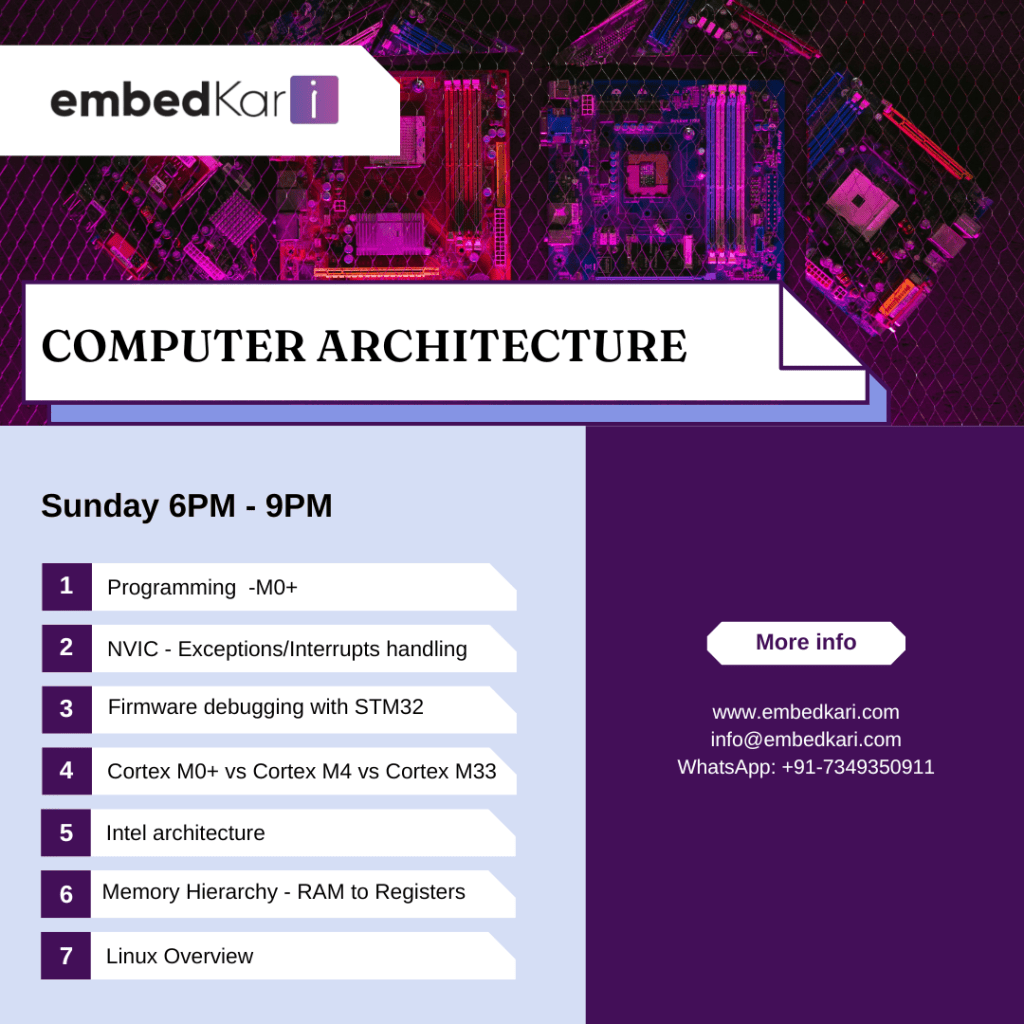
1️⃣ Programming Cortex-M0+: The Gateway to Embedded Development
Cortex-M0+ is a power-efficient microcontroller core ideal for low-cost and battery-powered applications. Learning to program M0+ helps developers:
✔️ Understand ARM architecture fundamentals
✔️ Optimize code for resource-constrained environments
✔️ Build low-power embedded solutions
2️⃣NVIC – Exception and Interrupt Handling
Interrupts are the backbone of real-time embedded systems. The Nested Vectored Interrupt Controller (NVIC) in Cortex-M microcontrollers enables efficient exception handling. Benefits of learning NVIC include:
✔️ Improving system responsiveness in real-time applications
✔️ Efficiently managing multiple interrupt sources
✔️ Reducing CPU load with priority-based interrupt handling
3️⃣ Firmware Debugging with STM32: Enhancing Software Reliability
Debugging embedded systems requires specialized tools and techniques. STM32 debugging skills help in:
✔️ Identifying and fixing firmware issues quickly
✔️ Using breakpoints, watch variables, and step execution
✔️ Mastering JTAG, SWD, and debugging protocols
4️⃣ Cortex-M0+ vs Cortex-M4 vs Cortex-M33: Choosing the Right Core
Different applications require different processing power and features. Comparing these architectures provides insights into:
✔️ When to use Cortex-M0+ (low-power applications)
✔️ Why Cortex-M4 is ideal for DSP and high-performance tasks
✔️ How Cortex-M33 enhances security with TrustZone
5️⃣ Intel Architecture: Expanding Embedded Horizons
Understanding Intel architectures helps embedded engineers work with diverse computing platforms. Key benefits include:
✔️ Learning how x86 differs from ARM-based microcontrollers
✔️ Optimizing performance for different processor architectures
✔️ Exploring embedded x86 solutions in industrial applications
6️⃣ Memory Hierarchy: From RAM to Registers
Memory management is key to embedded efficiency. Learning memory hierarchy helps developers:
✔️ Reduce execution time by optimizing cache usage
✔️ Understand stack and heap allocation in embedded firmware
✔️ Improve real-time performance with efficient memory access
7️⃣ Linux Essentials for Embedded Systems
Linux is widely used in embedded applications, and gaining Linux skills benefits developers by:
✔️ Understanding kernel internals and device drivers
✔️ Working with embedded Linux for real-time applications
✔️ Mastering shell scripting and cross-compilation for ARM
🚀 Why Should You Learn These Concepts?
🔹 Gain hands-on expertise in real-world embedded projects
🔹 Improve career prospects in IoT and embedded industries
🔹 Build optimized, efficient, and scalable embedded applications
Are you ready to dive deep into the world of embedded systems?
How much duration is required to Learn ?
All above concepts may take months to learn in depth but we are providing one 3 hour workshop to highlight key concepts.
Join our Computer Architecture Workshop and enhance your expertise!
📅 Date: Sunday (Registration FEE : 500 INR) , RazorPay . Fee is same for self paced or live session. One can purchase only online material or only live session. Total FEE for both is 1K.
🕕 Time: 6PM – 9PM(IST)
📍 Venue: Online
📧 Email: info@embedkari.com
📞 WhatsApp: +91-7349350911
Follow Embedkari on LinkedIn